Protecting Rural India: Why Every Farmer and Rural Entrepreneur Needs the Right Insurance Basket

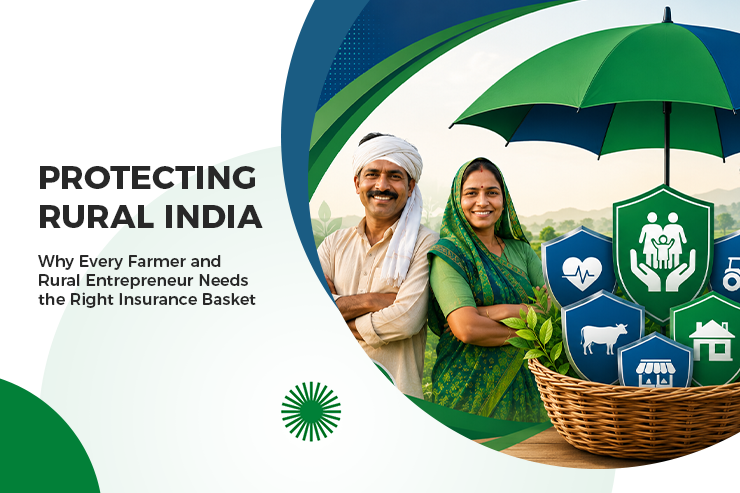
Farming in India has never been a safe bet. Droughts, floods, unseasonal rains, a sick animal, or one bad harvest can push a household from stability into debt within a season.
Yet most rural families carry these risks entirely on their own, with no financial backup beyond whatever savings they have managed to put aside.
The right insurance basket will not stop the rain from coming at the wrong time. But it can make sure that when it does, your family does not have to start over from nothing.
The Risk That Comes with Every Harvest
Manoj grows wheat and mustard on two acres in Vidarbha. Last kharif, unseasonal rains flattened his standing crop three weeks before harvest. He had no crop insurance. His savings, built over four careful years, lasted barely three months. By January, he was borrowing from a moneylender.
His story is one among thousands across rural India.
Strategies for agricultural risk management in India are becoming increasingly important as rural households face enormous risks every single day. Farmers face erratic rains, floods, and pest attacks. Rural shopkeepers face stock losses from power outages and floods. Dairy farmers can lose their entire herd to disease overnight. Yet most of these households have no financial protection beyond savings, which are rarely enough.
Insurance literacy in rural areas sits below 15 per cent, compared to 23 per cent nationally. The protection gap is wide and getting wider as climate events grow more severe. India's overall insurance penetration fell to 3.7 per cent in 2023-24, well below the global average of 7 per cent. The rural communities bear the brunt of this gap.
Why Rural Households Stay Uninsured
The problem is not just awareness. Several structural barriers keep affordable insurance for rural India out of reach.
1. Products built for urban buyers
Most insurance products are designed with salaried, city-based customers in mind. Rural incomes are seasonal, irregular, and often in cash. Annual premiums feel unaffordable when income arrives in one or two lump sums a year.
With average monthly rural household income between ₹8,000 and ₹10,000, affordable insurance for rural India remains essential for financial protection.
2. Awareness and trust deficits
Many farmers associate insurance with complicated paperwork and delayed or denied claims. Past experiences with slow settlements have built cultural resistance that is hard to overcome.
Despite years of government outreach, progress in rural insurance penetration has remained limited across many parts of India.
3. Limited distribution reach
Insurance agents rarely visit remote villages. Bank-linked insurance only reaches farmers with formal credit. Large sections of rural India, including horticulture workers, fishermen, and rural entrepreneurs, have no advisor to turn to.
Less than 10 per cent of Indian farmers have opted for crop insurance even after five decades of its availability.
What Agricultural Risk Management in India Looks Like Today
There is no single policy that covers every rural risk. The best insurance for small farmers in India is usually a combination of covers matched to their specific livelihood. Here is what is available in India today.
Crop Insurance (PMFBY)
The Pradhan Mantri Fasal Bima Yojana covers yield loss from natural disasters, pests, and disease. Farmer premium contributions are capped at 2 per cent for kharif crops and 1.5 per cent for rabi crops.
However, the scheme has well-documented drawbacks. Surveys take time, claim settlements are often slow and contested, and the enrolment process can be complicated for non-loanee farmers. Many farmers who file claims report waiting months with no resolution.
Private products are increasingly considered among the best insurance for small farmers in India because they often offer faster claims and clearer coverage terms. They often offer faster claim processing, clearer terms, and more transparent exclusions.
Parametric (Weather-Based) Insurance
This is a newer option that is gaining ground quickly, and it works very differently from traditional insurance.
With parametric insurance, no surveyor visits your farm. The trigger, say, rainfall below 250 mm during the sowing period, is tracked using data from the India Meteorological Department (IMD). If the threshold is crossed, the payout is released automatically. It arrives within days, not months.
Feature | Traditional (Indemnity) | Parametric |
Basis for payout | Actual crop loss assessed on-site | Pre-defined weather parameter crossed |
Survey required? | Yes | No |
Payout speed | Weeks to months | Days |
Transparency | Variable | High; trigger is pre-agreed |
Best for | Yield loss from multiple causes | Drought, excess rain, heatwave |
Livestock Insurance
For dairy farmers, this is a non-negotiable. A single animal can represent two to three years of savings. Private insurers offer livestock cover for cattle, buffalo, goats, sheep, and pigs. Compare premiums and exclusion clauses carefully, particularly around disease coverage, before you buy.
Health Insurance
General insurance providers offer health insurance plans with varying coverage options and premiums. Since some plans come with high premiums, farmers and rural shopkeepers often consider them inaccessible. However, private general insurance providers are now introducing affordable insurance for rural India through lower-premium health plans.
Life and Accident Cover
Government schemes like PMJJBY (₹2 lakh life cover for ₹436 per year) and PMSBY (₹2 lakh accident cover for ₹20 per year) are a reasonable floor. But their coverage is minimal.
If you need a payout that actually sustains a family after a death or permanent disability, private life and accident policies offer meaningfully higher sums insured at premiums that are still affordable.
What to Ask Before Buying Any Policy
Before enrolling in any rural insurance scheme or buying a policy, get answers to these five questions:
What exactly is covered? Ask the agent to name specific risks, such as drought, flood, pest attack, not just "natural calamity."
What are the exclusions? Every policy has risks it does not cover. Know them before you pay.
How is a claim filed? Find out the exact steps, including who to call, what documents are needed, and within how many days you must report a loss.
When does the payout arrive? Ask for the average claim settlement time, not just the promise.
Is this linked to my loan? Some crop insurance is compulsorily bundled with Kisan Credit Cards. Understand whether you are choosing this cover or it is being deducted automatically.
Wrapping Up: Taking Stock of What Protects You
Rural livelihoods face layered risks, including weather events, health emergencies, accidents, and livestock loss. No single policy covers all of them. The goal of agricultural risk management in India is to build a basket of covers that fits your income, crops, and family needs.
Start with the government schemes. Many are heavily subsidised. Then look at what gaps remain. Newer rural insurance options like parametric insurance are now reaching rural India with faster and fairer payouts.
DigiSafe Insurance can help you compare options across government and private insurers, so you choose what fits, not just what is available.
Frequently Asked Questions
Can a farmer buy more than one type of insurance at the same time?
Yes. Crop, health, livestock, and life insurance all cover different risks. Holding multiple policies is not just allowed, it is strongly advisable for full protection of a rural household.
Is parametric insurance only for large farmers?
No. Most parametric pilots in India have specifically targeted smallholders and marginalised groups. Products exist for women agricultural labourers, small dairy farmers, and even informal workers.
My village is remote. Can I still buy insurance?
Yes. Many insurers now enrol farmers through Common Service Centres (CSCs), bank correspondents, and trained PoSP agents who visit rural areas. Digital enrolment via the PMFBY portal is also available.
What documents do I typically need to buy crop insurance?
You usually need proof of land ownership or tenancy, a bank account linked to Aadhaar, a sowing certificate for the relevant crop, and identity proof. Requirements can vary slightly by insurer and state.


Comments